
Will EV Charging Become the Next Essential Holiday Park Amenity?
Five years ago, Holiday Parks were racing to install better Wi-Fi because guests expected it. Today, an increasing number of travellers are asking a different question before they book:
“Do you have EV charging?”
It might still be early days for much of the industry, but there’s little doubt electric vehicles are becoming a bigger part of Australia’s tourism landscape. Record fuel prices, ongoing uncertainty in global oil markets and continued government support for EV infrastructure have accelerated the transition, particularly over the past 12 months. Recent industry figures show Australians are buying electric and hybrid vehicles in record numbers, with almost half of all new vehicles sold during the April-June quarter now electrified.
For Holiday Park operators, the question is no longer if EVs will arrive at their front gate.
It’s when, and whether your park will be ready.
The New Guest Expectation
Today’s EV owner doesn’t simply need somewhere to sleep.
They need somewhere to recharge.
Just as travellers now expect reliable Wi-Fi, clean amenities and online booking, charging infrastructure is quickly becoming another factor influencing where people choose to stay—particularly on regional road trips.
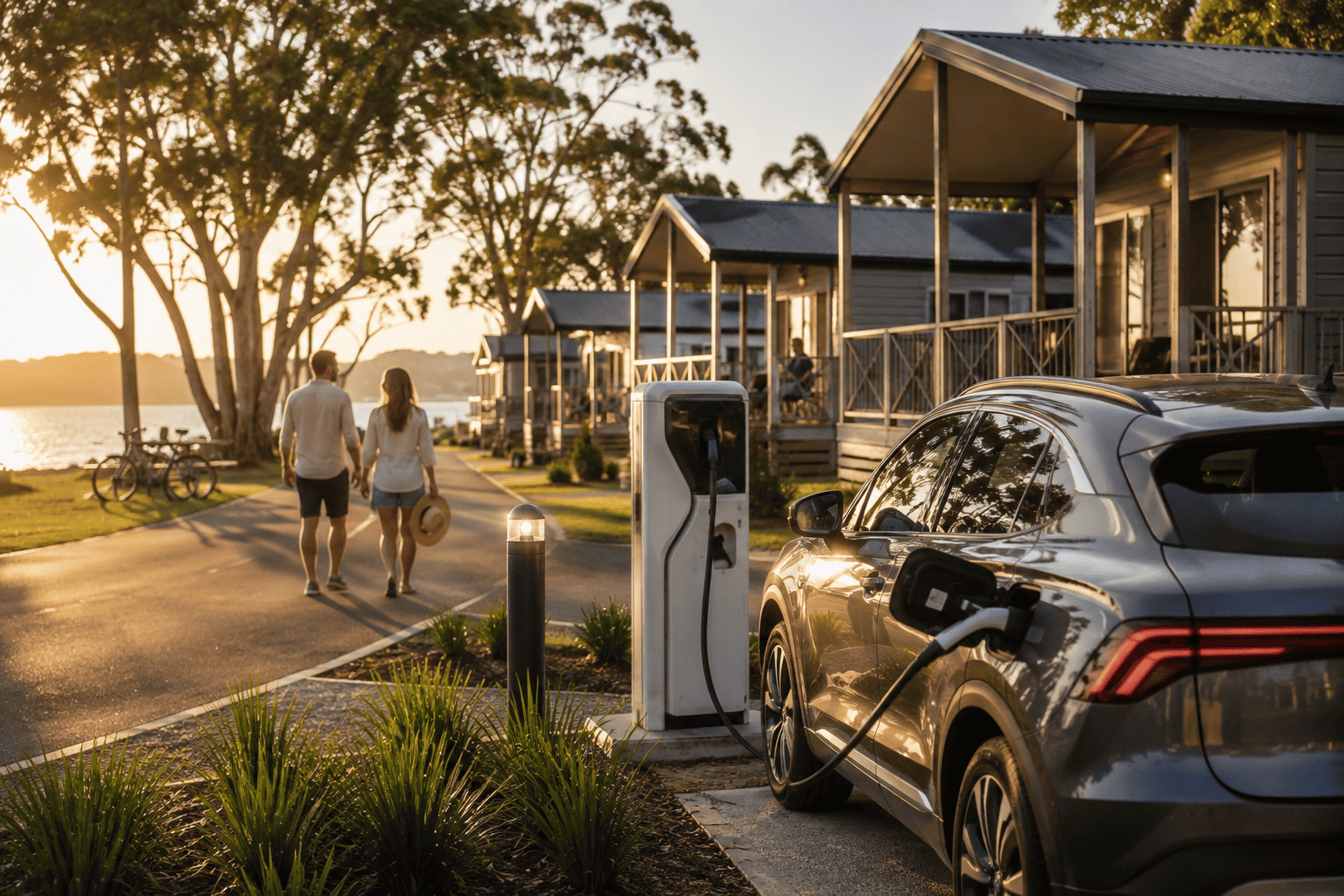
For cabin guests driving modern electric SUVs, destination charging is becoming an expected convenience rather than a luxury.
A New Revenue Opportunity
Unlike many park amenities, EV charging has the potential to generate income rather than simply create another operating expense.
Operators can:
- Charge users per kWh or per charging session.
- Attract higher-value guests who deliberately seek accommodation with charging facilities.
- Encourage travellers to stay overnight instead of continuing to the next town while waiting for a battery recharge.
- Increase spending in cafés, kiosks and park facilities while guests’ vehicles are charging.
For many parks, EV charging could become another premium service alongside upgraded cabins or pet-friendly facilities.
Which Charger Is Right?
Not every Holiday Park needs expensive ultra-fast chargers.
For many operators, destination chargers in the 7kW to 22kW range may be the smarter investment.
Guests typically remain parked overnight, making slower charging perfectly adequate while placing less demand on electrical infrastructure and installation costs.
The key is planning for tomorrow, not just today.
Installing conduit and electrical capacity during future upgrades may prove far cheaper than retrofitting an entire park five years from now.
Don’t Ignore Grants
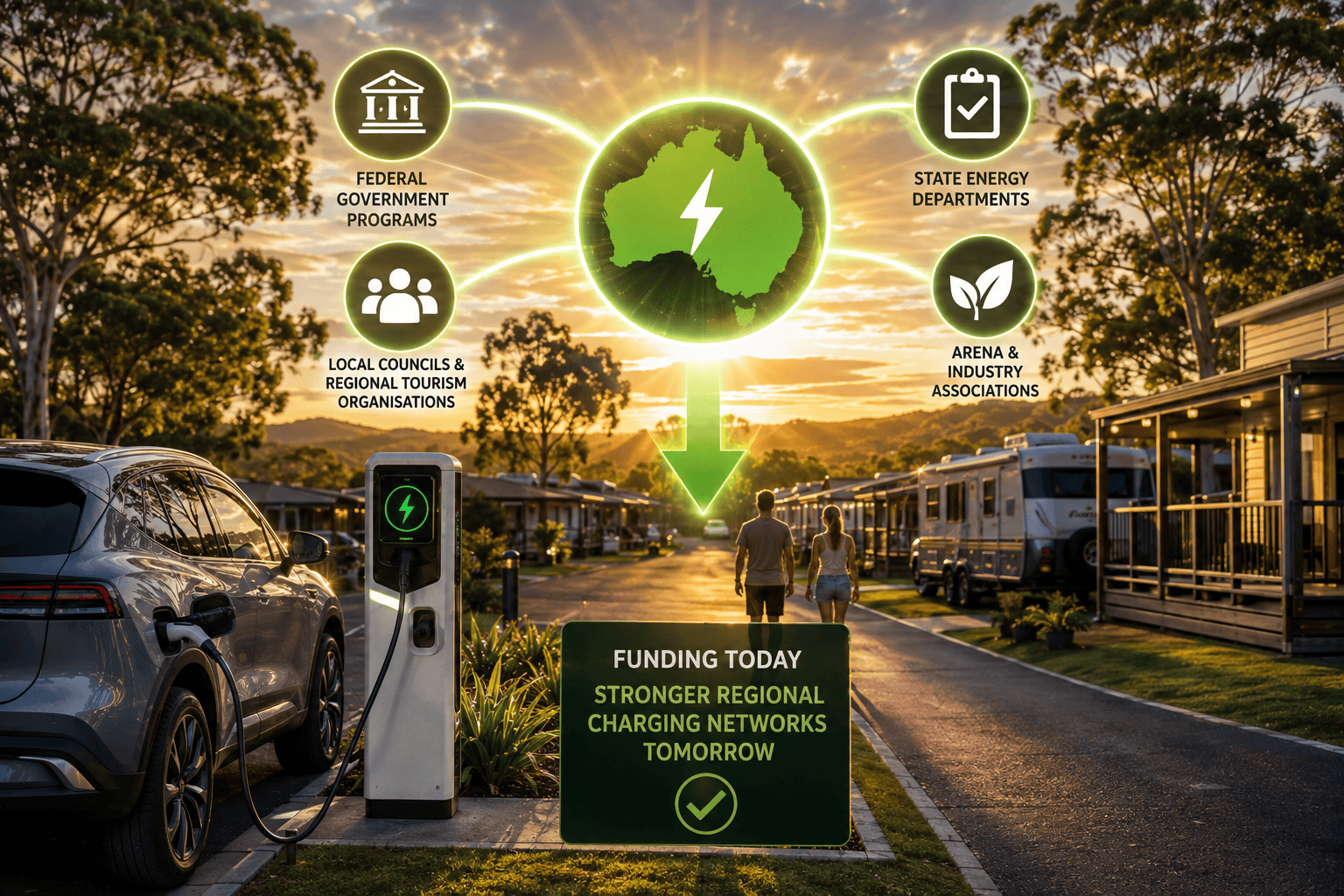
Federal and state governments continue investing heavily in regional charging infrastructure.
Programs delivered through initiatives such as the Driving the Nation Fund, together with various state-based destination charging schemes, have already funded hundreds of charging locations across Australia, particularly in regional tourism destinations.
Even if a grant round isn’t currently open in your state, operators should regularly monitor:
- Federal Government energy and transport programs
- State energy departments
- Local councils and regional tourism organisations
- ARENA and industry associations
Funding opportunities continue to evolve as governments prioritise regional charging networks.
But What About Caravan Owners?
This is where the conversation becomes more interesting.
Yes, several electric vehicles now tow caravans—including models such as the Tesla Model X, Kia EV9, BYD Shark 6 plug-in hybrid, Ford F-150 Lightning (where available) and others.
However, towing remains one of the biggest challenges for pure battery-electric touring.
A large caravan can reduce driving range by 40-60%, meaning many long-distance travellers still prefer diesel utes or are waiting for battery technology and charging infrastructure to mature.
Charging also presents practical challenges. Not every public charging station has sufficient space to accommodate a vehicle towing a caravan, often requiring travellers to unhitch before charging. While Australia’s charging network is expanding rapidly, many regional touring routes still have gaps that require careful planning.
For now, most EV guests arriving at Holiday Parks are likely to be:
- Cabin guests.
- Motorhome travellers without large trailers.
- Travellers using hybrids or plug-in hybrids.
- Owners of smaller camper trailers and lightweight caravans.
But that mix will continue to evolve.
Is EV Charging Inevitable?
Probably.
Not every Holiday Park needs to install chargers tomorrow.
Nor should every operator rush into an expensive investment before understanding guest demand.
However, ignoring the trend altogether could become the equivalent of refusing to install Wi-Fi 15 years ago.
As more Australians embrace electric vehicles and governments continue expanding regional charging networks, travellers will increasingly plan their holidays around where they can conveniently recharge.
The parks that begin planning now, understand the technology and monitor available funding will almost certainly be in a stronger position than those waiting until guests are already asking why the charger isn’t there.
The question may no longer be whether EV charging belongs in Holiday Parks.
It may simply be how soon it becomes as essential as the camp kitchen itself.