
The Insurance Inspection That Could Save YourHoliday Park Thousands
Most holiday park operators know what their insurance covers. But how many know
what their insurer could be doing to help prevent a claim in the first place?
Running a holiday or caravan park is a bit like owning a small town. You’ve got roads,
buildings, gardens, plumbing, electrical systems, recreational facilities and a constantly
changing population of people who sometimes do things that leave you scratching your
head.
And somewhere amongst all that, you’ve got to keep everyone safe.
Most operators take safety seriously. But even the best-run parks can develop problems that
go unnoticed, particularly when everyone is busy keeping guests happy, maintaining facilities
and dealing with the hundred other things that pop up before morning tea.
The trouble is, some of those little problems have the potential to become very expensive
ones.
It’s Often the Things You Don’t Notice
Think about the slightly uneven pathway near the amenities block. The tree that’s been
looking a little worse for wear. The playground equipment that’s perfectly fine, except nobody
can remember when it was last properly inspected.
Or perhaps the fire pits that have become increasingly popular with guests, but the park’s
procedures haven’t quite kept up.
None of these necessarily means there’s an immediate danger. But they are exactly the
sorts of things that deserve attention before something goes wrong.
And that’s where having the right insurance specialist involved can make a difference.
An Insurance Company That Actually Walks Around Your Park?
Here’s something that might surprise a few operators.
All Parks Insurance, a specialist provider to Australia’s holiday and caravan park industry,
offers a risk management program that goes considerably further than simply issuing a policy
and waiting for the phone to ring.
As part of its service to insured parks, All Parks conducts physical risk surveys, looking at
potential hazards and areas where operators may be unnecessarily exposed.
The process can include photographic reports identifying areas requiring attention,
recommendations around signage and disclaimers, and assistance developing appropriate
procedures for recreational activities.
In other words, they’re looking at what could go wrong before it actually does.
And there’s a fair bit of value in that.
Experience You Can’t Get From Sitting Behind a Desk
All Parks is headed by Julie Pernecker, who has spent close to three decades working with
Australia’s caravan and holiday park industry.
Julie has built a reputation for actually getting out and visiting parks, rather than relying
entirely on paperwork and conversations over the phone.
In fact, her industry involvement includes visiting parks on a rolling three-year rotation, even
when they’re not All Parks clients.
It’s a practical approach that recognises something fairly obvious: no two holiday parks are
exactly alike.
A coastal park dealing with salt exposure, storms and high guest turnover faces different
challenges from a regional park surrounded by mature trees, or a resort-style property with
pools, playgrounds and extensive recreational facilities.
Understanding those differences matters.
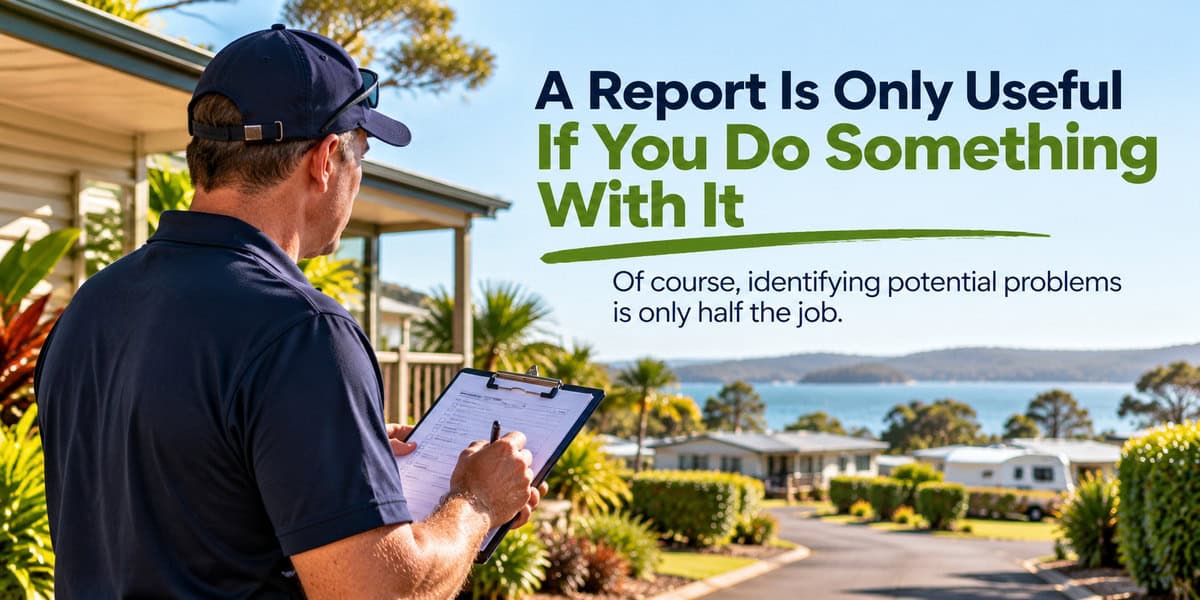
A Report Is Only Useful If You Do Something With It
Of course, identifying potential problems is only half the job.
If a risk assessment highlights something that needs attention, operators still need to act on
it.
That might mean arranging an inspection by a qualified professional, improving signage,
updating procedures or simply documenting maintenance work properly.
It’s not particularly glamorous stuff, and nobody’s likely to put photos of their newly updated
safety register on Instagram.
But should an incident occur, having appropriate procedures and maintenance records could
prove extremely important.
Prevention Beats the Paperwork
Insurance will always be an essential part of operating a holiday park. But it shouldn’t be the
only line of defence.
The real opportunity is identifying risks early, addressing them properly and potentially
avoiding the incident altogether.
For operators reviewing their insurance arrangements, it’s worth asking a simple question:
Does your insurance provider simply cover the risks, or can they also help you identify them?
Because the best insurance claim might just be the one you never have to make.
Find out more: https://allparks.com.au/