
What Really Keeps Guests Coming Back? The Top 5 Things Holiday Park GuestsValue Most
Article by Warren Parrot – @whatsupwithwaz
There is no single formula for the perfect caravan or holiday park.
For one family, the dream park might have a swimming pool, playground, jumping pillow and
enough activities to ensure the kids are exhausted by 8pm.
For a retired couple touring Australia, perfection might be a large, level site, immaculate
amenities, friendly managers and somewhere peaceful to enjoy a glass of wine at the end of
the day.
A younger couple might be looking for something different again – a great location, pet-
friendly facilities, Wi-Fi, access to local experiences and somewhere that represents good
value.
And that’s an important distinction.
Australia’s holiday park market isn’t one audience. Nor are all parks trying to be the same
thing.
From independently owned regional caravan parks and council-operated facilities through to
large holiday resorts and national park groups, each has its own market, location, facilities
and personality.
But when we looked at what Australian travellers consistently talk about in reviews,
caravanning discussions and industry research, some remarkably common themes
emerged.
So rather than asking “What facilities should every park have?”, perhaps the better
question is:
“What makes guests want to come back?”
Here are five things that appear again and again.
1. Cleanliness – the great equaliser
You don’t necessarily need the newest amenities block in Australia.
But it needs to be clean.
Clean toilets, showers, camp kitchens, cabins and well-maintained grounds consistently
appear in positive park reviews. Interestingly, travellers regularly praise older or simpler
parks specifically because they are exceptionally clean.
For cabin guests, expectations extend to linen, bathrooms, kitchens and general
presentation.
It’s one area where a modest regional park can compete on completely equal terms with a
large resort.
Guests may not remember the colour of the bathroom tiles.
They’ll certainly remember whether the shower was clean.
2. Value – which doesn’t necessarily mean cheap
Value is becoming increasingly important.
Caravan Industry Association of Australia research shows Australians took 17.3 million
caravan and camping trips during 2025, generating 57.9 million visitor nights and $12.6
billion in expenditure. But travellers are increasingly prioritising value, with trips becoming
shorter and closer to home.
That doesn’t mean every park needs to compete on price.
A family may happily pay more for a park offering pools, playgrounds, jumping pillows,
activities and entertainment because those facilities form part of their holiday.
Likewise, a caravanning couple might happily pay a premium for a waterfront site, private
ensuite or exceptional location.
Value is ultimately about whether the experience matches the price.
That’s a very different proposition from simply being the cheapest park in town.
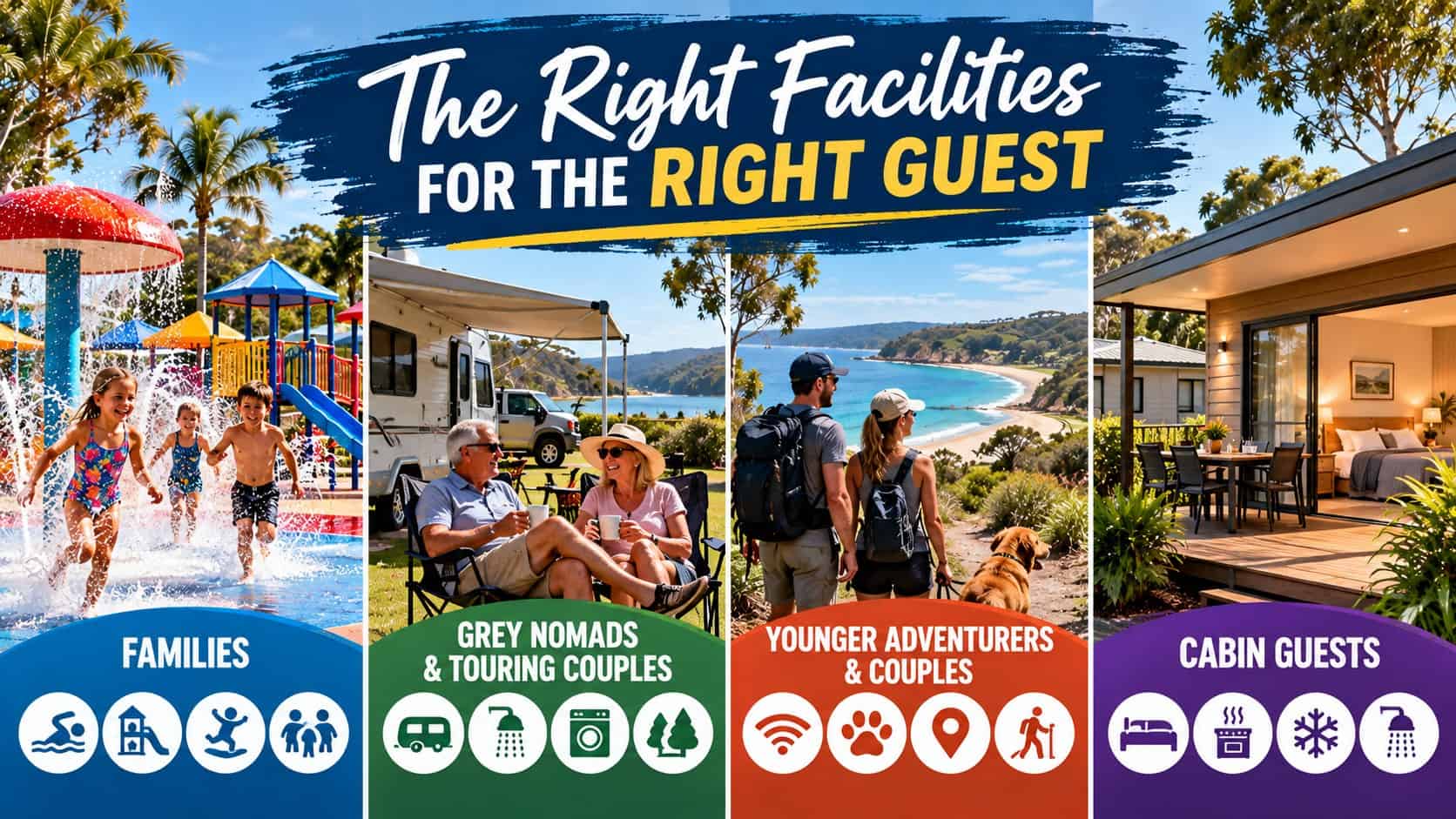
3. The right facilities for the right guest
Here’s where the “Top 5” becomes interesting.
Different guests genuinely want different things.
Families may place pools, playgrounds, jumping pillows, kids’ activities, camp kitchens and
safe areas for bikes and scooters high on their list.
Grey nomads and touring couples may prioritise large accessible sites, clean amenities,
laundry facilities, peace and quiet, security and friendly management.
Younger adventurers and couples might place greater importance on location, Wi-Fi, pet
friendliness, communal areas and easy access to local attractions, beaches, walking tracks,
food and experiences.
Cabin guests are likely to judge the accommodation more like traditional accommodation –
comfortable beds, cleanliness, heating and cooling, kitchens, bathrooms and overall
presentation matter.
None is more important than the other.
The lesson is knowing who your park is for – and doing those things particularly well.
4. Service and the human factor
This may be one of the least expensive competitive advantages a park can have.
“Friendly staff”, “helpful managers”, “welcoming reception” and “nothing was too much
trouble” appear constantly in positive reviews.
And there’s a reason.
A guest may interact with reception for only a few minutes, but that interaction can set the
tone for the entire stay.
It’s also what happens when something goes wrong.
A difficult site, booking mistake, maintenance issue or noisy neighbour doesn’t automatically
create a negative review. How the park responds can make an enormous difference.
For independent and smaller parks in particular, this can be a genuine strength. Knowing
someone’s name, helping them onto a site or simply having a friendly chat can create
something no capital expenditure program can buy: a connection with the guest.
5. A park that feels good to stay in
This one’s harder to put on a spreadsheet.
It’s the overall experience.
Guests regularly mention peaceful surroundings, safety, tidy grounds, respectful neighbours,
good site spacing, attractive landscaping and the general atmosphere of a park.
Research involving almost 3,000 participants in Caravan Industry Association of Australia’s
Caravan to a Million campaign found that 89% of RV owners continued to use caravan
holiday parks, with amenities, safety and social opportunities among the leading reasons.
That combination is significant.
People don’t simply buy a patch of ground for the night. They’re buying an experience –
whether that’s a lively family holiday, a quiet overnight stop, three months escaping a
southern winter or a weekend cabin getaway.
And sometimes the little things make the biggest difference.
There isn’t one perfect holiday park
Perhaps that’s the most important finding of all.
A small council park beside a country river doesn’t need to become a family resort.
An independent park catering primarily to touring couples doesn’t necessarily need the same
facilities as a major coastal holiday destination.
And a large family holiday park shouldn’t apologise for investing heavily in pools,
playgrounds, jumping pillows and entertainment when that’s exactly what its guests want.
The successful parks tend to understand their particular customer.
Across the different demographics, however, the fundamentals remain remarkably similar:
Keep it clean. Offer genuine value. Provide facilities appropriate to your market. Look
after your guests. And create an environment people enjoy being in.
Because getting somebody to stay once is good business.
Giving them a reason to say “We’ll definitely be back” is even better.