
10 Things Holiday Park Operators Should Know Right Now
The Holiday Park industry rarely stands still for long, and the past fortnight has been a good
example.
From major changes to Working Holiday Maker visas and rising regional fuel prices to
government-subsidised camping, planning reform and the arrival of the new Spirit of
Tasmania vessels, there are several developments worth having on the radar.
Some are national issues. Others are state or regional developments that could provide an
indication of what may eventually happen elsewhere.
Here are 10 things Australian Holiday Park owners and operators should know right now.
1. Working Holiday Maker Changes Could Make Finding Staff Even Harder
The Federal Government has announced significant changes to Australia’s Working Holiday
Maker visa program, including introducing a ballot for people seeking second and third-year
visas.
Second-year places will be capped at 45,000, compared with 57,000 people who qualified
last year. The bigger reduction comes with third-year visas, which will be limited to just 5,000
places compared with 31,000 last year.
The requirement to undertake specified regional work remains but completing that work will
no longer guarantee another year in Australia.
Tourism industry representatives have warned the changes could make an already difficult
regional workforce situation even tougher.
Why it matters to Holiday Parks: Backpackers and Working Holiday Makers have long
provided an important seasonal workforce for regional tourism businesses, including Holiday
Parks.
Reception, housekeeping, grounds, maintenance, hospitality and seasonal roles can already
be difficult to fill in regional areas. Operators who traditionally rely on international workers
may need to start recruitment earlier, broaden where they look for staff and reconsider how
they retain good seasonal employees.
For more information on Australia’s Working Holiday Maker program, visit Australian
Department of Home Affairs
2. The New Spirit of Tasmania Ships Could Be Massive for Caravan Tourism
This could be one of the biggest developments for Tasmanian drive tourism in years.
Tickets for the new Spirit of Tasmania IV and Spirit of Tasmania V went on sale in
September and demand was extraordinary. Around 150,000 visits hit the booking system
within the first half-hour, compared with approximately 2,000 visits on a normal day.
The new ships will have 301 cabins, room for an additional 470 passengers and — most
importantly for our industry — around three times the caravan capacity of the existing
vessels.
They will also have increased vehicle lane length and height, making it easier to
accommodate caravans, motorhomes and camper trailers. Passenger sailings are
scheduled to commence from Geelong and Devonport on 31 October.
Tourism Tasmania clearly recognises the opportunity. It has developed a dedicated caravan
and motorhome market plan specifically in response to the expected increase in visitation
created by the new vessels.
There will also be a Tasmania Concierge available aboard the ships, allowing passengers
to research their self-drive trip, book participating Tasmanian tourism operators and send
their itinerary directly to their phone before they drive off the ship.
Tourism Tasmania says Spirit passengers tend to stay longer, spend more and travel
further throughout the state — exactly the sort of visitor regional Holiday Parks want.
Why it matters to Holiday Parks: Three times the caravan capacity potentially means a lot
more caravans and RVs rolling off the ships at Devonport.
If caravanners and campers embrace the new vessels, the benefits shouldn’t stop at
Devonport or Hobart. These visitors have their own vehicles, accommodation and time,
making them ideally suited to dispersing through regional Tasmania.
For Tasmanian Holiday Parks, now is the time to make sure websites, Google listings,
booking systems, imagery and regional tourism relationships are doing their job. The extra
capacity is coming — the opportunity is converting those vehicle spaces into nights spent in
Holiday Parks around the state.
Learn more about the new vessels, increased vehicle capacity and upcoming sailings at
Spirit of Tasmania
3. Rising Fuel Prices Put Regional Touring Costs Back Under Pressure
Fuel has again become a significant issue for regional Australia, with petrol and diesel prices
rising following renewed instability in the Middle East.
Diesel has reportedly approached $3 per litre in some regional locations.
For someone towing a large caravan or travelling Australia in a motorhome, that’s
considerably more painful than filling the family hatchback before the school run.
Why it matters to Holiday Parks: High fuel prices don’t necessarily stop people travelling,
but they can change how they travel.
Caravanners may shorten distances between stops, stay longer in one location, choose
destinations closer to home or reduce discretionary spending once they arrive.
That creates an opportunity as well as a challenge. Parks can encourage longer stays
through packages, local itineraries and information showing guests there is enough nearby
to justify parking the van for several days rather than moving every morning.
For current Australian fuel price information and consumer resources, visit Australian
Competition & Consumer Commission — Fuel in Australia
4. Victoria’s Half-Price Government Camping Continues
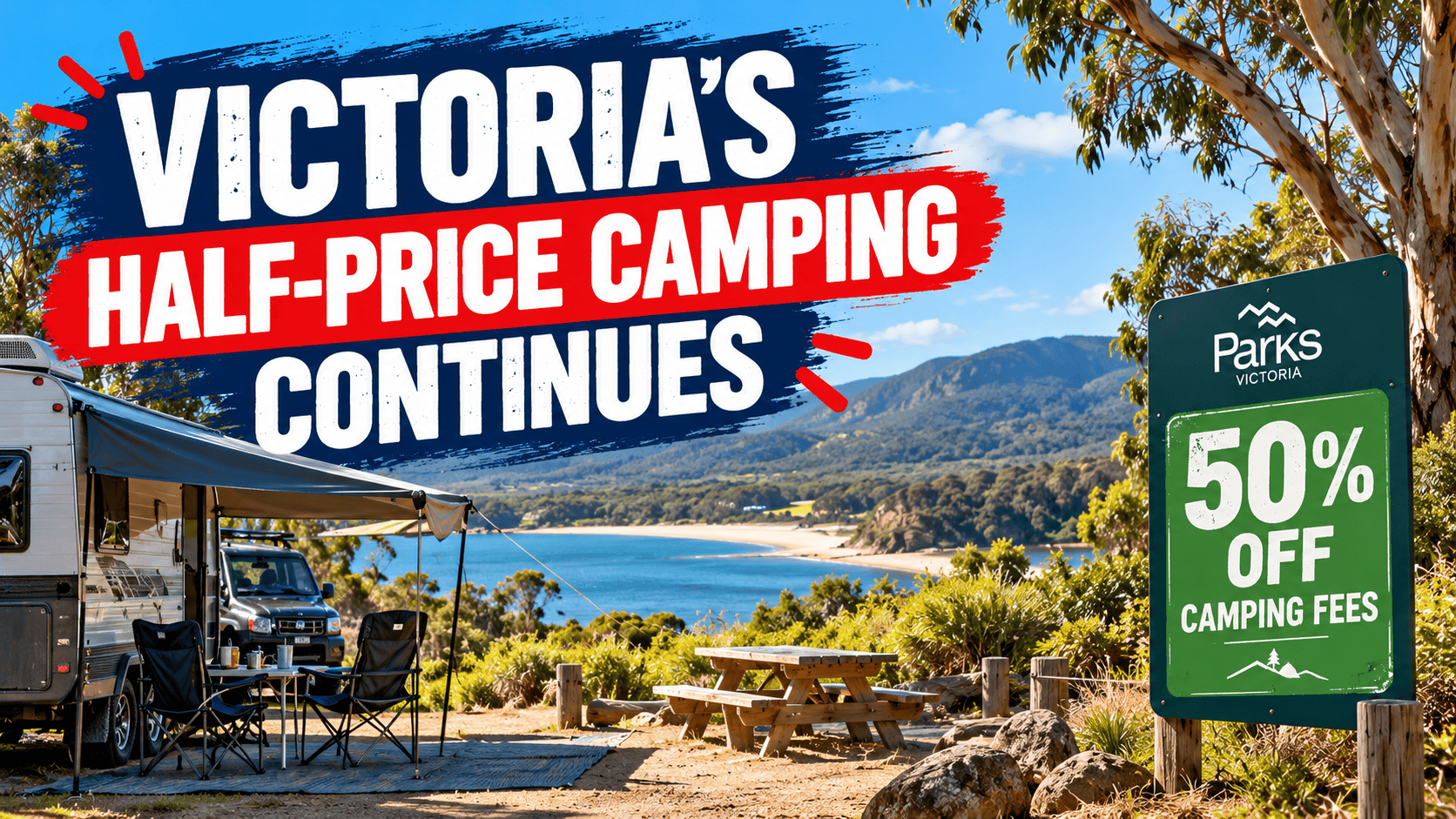
The Victorian Government is investing $10.5 million to maintain half-price camping at Parks
Victoria campgrounds until July 2027.
The scheme applies across Parks Victoria’s bookable campgrounds, with the government
saying campers have saved more than $25 million in booking fees since half-price camping
was first introduced in 2019.
Making camping more affordable is obviously good news for consumers and can encourage
more people to get out and explore regional Victoria.
There is, however, another side to the equation.
Why it matters to Holiday Parks: Commercial Holiday Parks operate with wages,
insurance, utilities, rates, compliance requirements, maintenance costs and significant
ongoing investment in facilities.
Government-supported camping at substantially reduced prices can therefore create a very
different competitive environment.
Private operators aren’t simply competing park against park — in some locations they’re
competing against accommodation where government funding effectively reduces the price
paid by the customer.
That makes differentiation increasingly important: amenities, powered sites, pools, camp
kitchens, security, family facilities, Wi-Fi, pet-friendly facilities, location and service all
become part of explaining why a commercial Holiday Park offers value beyond simply
providing somewhere to put a tent or caravan.
See the Victorian Government’s current half-price camping program and booking information
at Parks Victoria
5. NSW Planning Changes Could Affect Parks and Manufactured Homes
NSW is progressing significant reforms involving manufactured homes following passage of
the Building (Approvals and Practitioners) Act 2026.
The changes will eventually bring approval and certification requirements for manufactured
homes closer to those applying to traditionally constructed buildings.
The NSW Government has confirmed further planning-system amendments will be required,
including new terminology, consent pathways and development standards, with stakeholder
consultation to occur before the changes are implemented. Existing processes remain in
place until the relevant provisions commence.
Why it matters to Holiday Parks: Planning and certification reform can affect development
costs, approvals, expansion plans and the operation of parks containing manufactured or
moveable accommodation.
NSW operators in particular should watch the consultation process closely rather than
discovering the practical implications once the new rules are already in place.
For operators elsewhere, it’s worth watching too. Planning reforms in one state can
sometimes provide a template — good or bad — for changes considered in another.
Follow the latest planning information affecting caravan parks, manufactured-home estates
and moveable dwellings through NSW Planning
6. Queensland Parks Push for a Bigger Voice in Regional Planning
The Caravan Parks Association of Queensland has lodged a submission on the Draft Wide
Bay Burnett Regional Plan and Infrastructure Plan 2026, representing 55 caravan and
residential parks across the region.
The association argues caravan and residential parks need to be recognised as an important
part of regional Queensland’s tourism, housing and economic mix rather than being treated
as an afterthought during long-term planning.
The plan can influence everything from where future development occurs to infrastructure
and tourism-road investment.
Why it matters to Holiday Parks: Regional plans can sound like documents destined to
spend the next decade gathering dust on a government shelf, but their decisions can
ultimately determine whether a park can expand, where new tourism accommodation can be
developed and what infrastructure supports it.
The Wide Bay Burnett process is Queensland-specific, but the lesson is national: when
councils and governments ask for industry submissions, Holiday Parks need a seat at the
table.
For information on Queensland’s regional planning framework and the Wide Bay Burnett
region, visit Queensland Government Planning
7. Kiama Reviews the Future Management of its Holiday Parks
Kiama Municipal Council is considering the future management of its Holiday Park portfolio
after receiving unsolicited proposals from private operators.
Council manages five Holiday Parks, with four situated on Crown Land. Three unsolicited
proposals were received earlier this year seeking to operate, manage or take over leases
associated with the parks.
Council has stressed that the parks are valuable community assets as well as important
visitor accommodation.
Why it matters to Holiday Parks: The Kiama situation raises a much broader industry
question about the future operation of council-owned Holiday Parks.
Across Australia, councils control valuable Holiday Park assets, often in exceptional
waterfront or regional locations. Decisions around leasing, private management,
reinvestment and commercial operation can alter competition within a destination
considerably.
Operators should keep an eye on what happens in Kiama — particularly those operating in
regions where council-owned parks compete directly with privately owned businesses.
Follow developments involving the future management of Kiama’s Holiday Parks through
Kiama Municipal Council
8. Tasmania Is Taking More Government Campground Bookings Online
Tasmania’s new $2 million Parks Online Booking System has entered final testing, with the
first stage scheduled to launch on 3 November.
Initially, visitors will be able to book sites at selected campgrounds including Narawntapu
National Park, Freycinet National Park and Fortescue Bay.
The system will eventually bring campsites, walking experiences, cave tours, park passes
and other products together through one online portal.
All happening just in time to coincide with the new Spirit of Tasmania capacity –
coincidence? I think not…
Why it matters to Holiday Parks: Government camping is becoming easier to research and
book.
Consumers increasingly expect to check availability, understand exactly what they’re buying
and complete a booking on their phone without making three phone calls and sending a
carrier pigeon.
For commercial Holiday Parks, the benchmark for a good online booking experience isn’t
just the park down the road anymore. Every accommodation and camping provider
competing for that traveller is helping establish the standard customers expect.
Read more about the new campground booking system through the Tasmanian Government
announcement
9. Illegal Camping Pressure Resurfaces in Cairns
Illegal camping around Buchan Point near Cairns has again become a significant local issue.
Despite signage prohibiting camping, the area has reportedly continued attracting people
staying overnight, creating concerns around rubbish, sanitation, public access and
enforcement.
Responsibility is complicated by different government agencies controlling different aspects
of the area, while affordability pressures are also contributing to the problem.
Why it matters to Holiday Parks: This is bigger than one Cairns car park.
Holiday Parks provide toilets, showers, waste disposal, water, security, maintained grounds
and other infrastructure — and pay the considerable costs associated with providing them.
When travellers are permitted, intentionally or otherwise, to establish unofficial camps in
nearby public areas, legitimate accommodation operators can find themselves competing
with an option carrying few of the same operating costs or regulatory obligations.
There is also a destination-management issue. Poorly managed illegal camping can damage
local amenity and community attitudes towards legitimate caravanners, campers and RV
travellers who overwhelmingly do the right thing.
For information on camping rules, local laws and visitor information in the Cairns region, visit
Cairns Regional Council.
10. $70 Million Kakadu Road Program Starts Delivering
The first project under the Australian Government’s $70 million Kakadu tourism-road
investment has been completed.
Kubara Road has been raised and realigned, with drainage and flood-resilience
improvements designed to provide safer and more reliable access during wet weather.
Further works are underway on Maguk Road and Jim Jim Falls Road, with upgrades to
Gimbat and Gunlom roads also expected to begin.
Why it matters to Holiday Parks: Roads are effectively part of the tourism product.
Better roads and longer periods of reliable access can encourage travellers to stay in a
region longer, explore more attractions and potentially extend the viable tourism season.
For Holiday Parks across the Top End, particularly those servicing self-drive visitors heading
towards Kakadu, improved access can ultimately mean more vehicles, more visitor nights
and greater regional tourism expenditure.
Follow the road upgrade program and other visitor developments through Kakadu National
Park — Parks Australia
The Bigger Picture
What connects these ten stories is that very few of the biggest influences on a Holiday Park
actually happen inside the park gates.
Visa policy affects who is available to work. Fuel prices influence where guests travel. Ferry
capacity determines how easily caravans reach an island state. Government camping
policies influence competition. Planning regulations affect investment, and road
infrastructure determines whether visitors can comfortably reach a destination in the first
place.
That’s why keeping an eye on the wider tourism, government and regional landscape
matters.
Sometimes a seemingly small announcement today can have a surprisingly large effect on
bookings, costs or competition tomorrow.
And in the case of Tasmania and those new Spirit vessels, the effect might not be small at
all.