
Record Revenue… But Are Holiday Parks Really Better Off?
By Warren Parrot
Australia’s caravan and holiday park industry has every reason to celebrate. The latest State of the Industry 2026 report paints an incredibly positive picture, with Australians taking a record 17.3 million caravan and camping trips during 2025, generating 57.9 million visitor nights and spending $12.6 billion—the highest figures the industry has ever recorded.
It’s another milestone that confirms caravanning and camping remains one of Australia’s favourite ways to holiday.
The numbers don’t stop there. Commercial holiday parks continue to dominate the market, accounting for around two-thirds of all caravan and camping trips, more than 70 per cent of visitor nights and around three-quarters of total visitor expenditure.
Even more encouraging is the fact that 87 per cent of all caravan and camping trips occur in regional Australia, reinforcing just how important Holiday Parks have become to local economies and regional tourism.
On paper, it sounds like the perfect success story.
But spend five minutes talking with almost any Holiday Park owner or manager and you’ll quickly discover another story entirely.
Yes, parks are busy.
Yes, guests are travelling.
Yes, revenue is growing.
So why does it still feel harder than ever to run a profitable Holiday Park?
Revenue Doesn’t Equal Profit
One of the biggest misconceptions in business is that increased revenue automatically means increased profitability.
Anyone operating a Holiday Park in 2026 knows that’s simply not the case.
While occupancy has remained strong across much of Australia, with some slow down over the last couple of months due to the fuel crisis, the cost of delivering the Holiday Park experience has increased dramatically over the past few years.
Insurance premiums continue to climb, particularly in regions exposed to floods, bushfires and severe weather. Electricity costs remain volatile, water charges have increased in many jurisdictions, wages continue to rise and finding quality staff remains one of the industry’s biggest ongoing challenges.
Then there are the costs guests never see.
Replacing cabins. Maintaining roads. Upgrading amenities. Meeting new compliance requirements. Booking software. Payment processing fees. Online travel agent commissions. Cyber security. Wi-Fi infrastructure. Minimum wage increases due to cost of living pressures also have an impact.
Every one of these expenses has grown, meaning that while turnover may be setting records, margins are often under increasing pressure.
For many operators, the challenge is no longer filling the park. It’s making sure every occupied site or cabin is genuinely profitable.
The Modern Holiday Guest Has Changed
The latest industry figures also highlight another important trend.
Australians are still travelling—but they’re travelling differently.
According to the Caravan Industry Association of Australia, travellers are increasingly prioritising value, taking shorter holidays, staying closer to home and making booking decisions much later than they once did. Average trip length has fallen to around 3.4 nights, reflecting changing consumer behaviour amid ongoing cost-of-living pressures.
This shift creates both challenges and opportunities.
The days when many guests booked their annual holiday months in advance has been reducing.
Today’s traveller often decides only days—or even hours—before departure. That means Holiday Parks, especially if you are a single dot on a map, need to think differently and market themselves differently.
Availability needs to be visible online. Booking systems need to be seamless. Social media needs to stay active. Websites need to inspire confidence.
Direct bookings have never been more important.
The parks that adapt quickest to this new booking behaviour will almost certainly be the ones that continue to outperform.
Expectations Have Never Been Higher
Guests aren’t simply looking for somewhere to park the caravan anymore.
They’re looking for an experience.
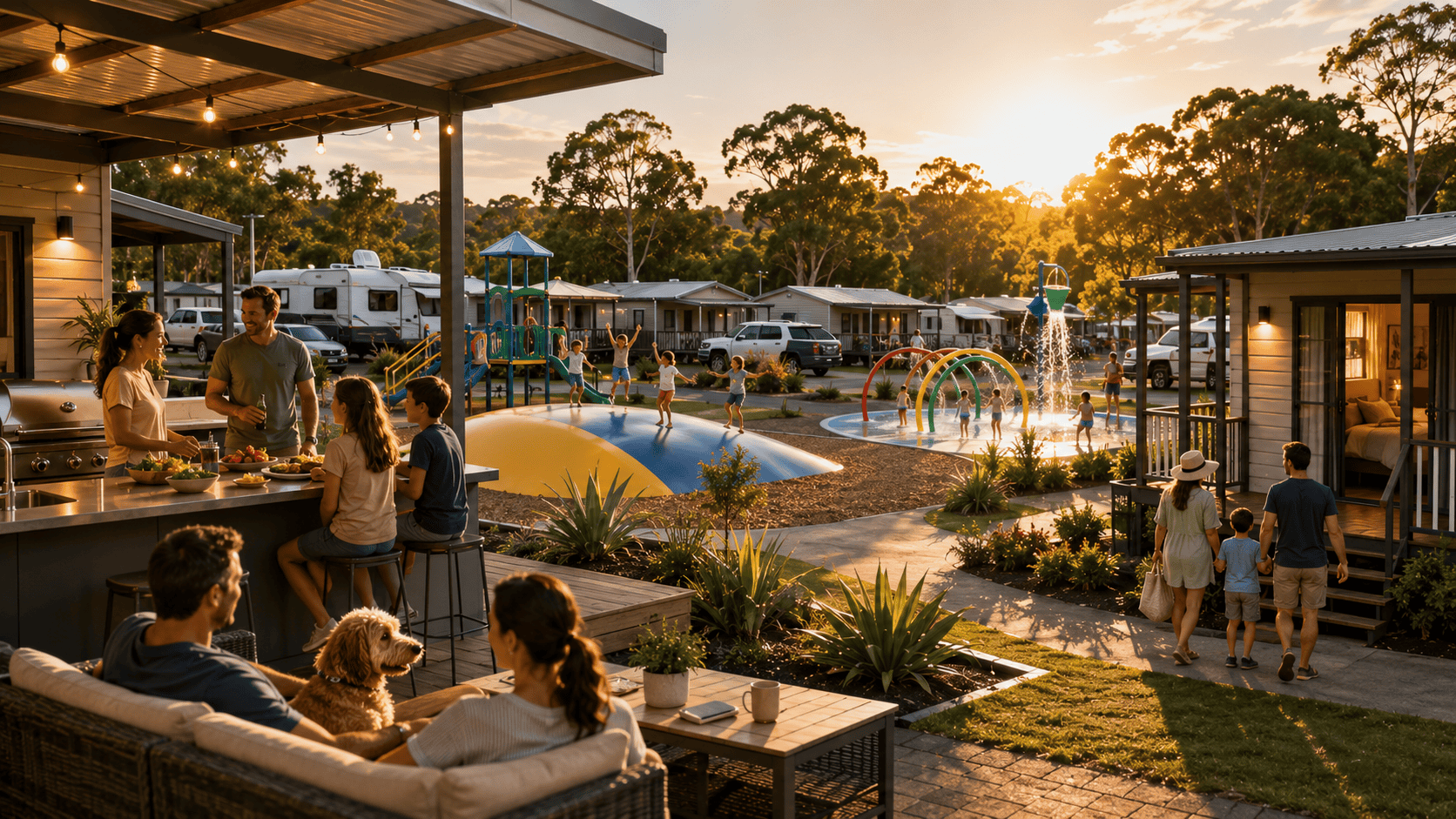
Fast Wi-Fi. Modern amenities. Pet-friendly facilities. Premium cabins. Spacious Caravan sites.
The families want to see excellent playgrounds, Jumping pillows, Splash parks, unique Camp kitchens that feel more like outdoor entertaining areas.
When booking they want Easy online check-in, Instant responses to enquiries, Spotless amenities.
These expectations aren’t unreasonable—but they do require ongoing investment.
As you all know, Holiday Parks have evolved dramatically over the past decade, and today’s successful operators understand they’re competing with hotels, resorts, Airbnb properties and international holidays for the same discretionary tourism dollar.
The guest experiences that we offer have become one of the industry’s most valuable competitive advantages.
Investment Is Driving Success
Perhaps one of the biggest lessons from the industry’s recent growth is that successful Holiday Parks are no longer relying solely on occupancy.
They’re creating reasons for guests to stay longer. They’re investing in premium accommodation. They’re adding family attractions. They’re embracing pet-friendly travel.
They’re hosting food trucks, live music, school holiday activities and community events.
They’re partnering with local tourism operators to create destination experiences rather than simply providing accommodation.
Increasingly, the parks seeing the strongest returns are those focusing on the lifetime value of every guest rather than simply maximising occupancy during peak periods.
A one-night stay can become three nights. A first-time guest can become an annual visitor.
That’s where long-term profitability is built.

Looking Beyond the Headlines
The latest State of the Industry report should absolutely be celebrated.
Record visitation. Record expenditure. Continued strength in regional tourism.
These are fantastic outcomes not only for Holiday Parks but for the thousands of regional businesses that benefit whenever Australians choose to holiday closer to home.
However, perhaps the biggest takeaway isn’t that the industry has reached record revenue. It’s that success is becoming more sophisticated.
Tomorrow’s most successful Holiday Parks won’t necessarily be the biggest.
They’ll be the operators who understand their numbers, embrace technology, invest wisely, deliver exceptional guest experiences and continually adapt to changing traveller expectations.
In many ways, that’s good news.
Because while external factors like fuel prices, interest rates and weather will always influence tourism, the things operators can control—service, presentation, marketing, efficiency and guest satisfaction—remain firmly in their own hands.
Five Questions Every Holiday Park Should Be Asking
As the industry enters another financial year of strong demand, every owner and manager might consider asking themselves:
- Is our revenue increasing faster than our operating costs?
- What can we do to encourage guests to stay just one extra night?
- Are we investing in facilities that genuinely improve guest satisfaction and return on investment?
- Could our park benefit from being part of a larger network that helps increase visibility, build traveller confidence and generate more bookings?
- If today’s traveller is booking later and expecting more, are we evolving quickly enough to meet those expectations?
The caravan and Holiday Park industry has never been more important to Australia’s visitor economy.
The latest figures prove Australians still love the freedom of the open road and the unique experiences Holiday Parks offer.
The challenge now isn’t attracting travellers.
It’s ensuring that record visitation translates into sustainable, long-term profitability for the businesses welcoming them.
Because while record revenue makes the headlines, it’s smart management, continual innovation and exceptional guest experiences that will determine who thrives in the years ahead.