
10 Ways Smart Holiday Parks Are Already Using AI
Artificial Intelligence has arrived. The question isn’t whether Holiday Parks should use it… it’s how.
By Warren Parrot – @whatsupwithwaz
Artificial Intelligence (AI) has rapidly become one of the biggest talking points not just in business but the entire world.
Every week there’s another headline predicting that AI will change everything, replace jobs or completely transform the way we work. For many Holiday Park owners and managers, that can feel overwhelming. Some are embracing AI with enthusiasm, while others are wondering whether it’s simply another technology trend that will eventually fade away (FYI – it wont!).
The reality is much simpler.
AI isn’t about replacing people.
It’s about helping good people work smarter.
For Holiday Parks—where owners and managers often wear multiple hats every day—AI has the potential to become one of the most valuable business tools available. Whether you’re managing guest enquiries, creating marketing campaigns, responding to online reviews or planning maintenance, AI can save hours every week while helping deliver a better guest experience.
The best part?
You don’t need to be a technology expert to start using it.
Here are ten practical ways Holiday Parks around Australia are already putting AI to work.
1. Answering Guest Emails Faster
Every Holiday Park receives dozens of similar emails every week.
“What time is check-in?”
“Are pets allowed?”
“Can I bring a boat?”
“What facilities do you have?”
Instead of writing every reply from scratch, AI can draft professional, personalised responses in seconds.
Managers simply review the response, make any adjustments and press send.
It doesn’t replace customer service—it simply removes the repetitive typing.
2. Responding to Online Reviews
Whether it’s Google Reviews, Facebook, TripAdvisor or other booking platforms, guests increasingly expect businesses to respond to reviews.
The challenge is finding the time.
AI can draft thoughtful responses to both positive and negative reviews while maintaining a consistent tone of voice.
Park managers can then personalise the response before publishing.
Responding consistently also sends a strong message to future guests that management genuinely listens to feedback.
3. Creating Better Social Media Content
Many operators know they should post more regularly on social media.
The problem is deciding what to post.
AI can generate ideas for:
- School holiday promotions
- Local event reminders
- Pet-friendly travel tips
- Seasonal camping advice
- Guest stories
- Local attractions
- Park updates
- Weather-related travel ideas
It can even suggest captions, hashtags and posting schedules.
Instead of staring at a blank screen, managers have a ready-made starting point every time.
4. Writing Marketing Content
Creating brochures, website articles, newsletters and eDM campaigns can consume hours.
AI can help draft:
- Website copy
- Park descriptions
- Accommodation listings
- Special offers
- Blog articles
- Newsletters
- Media releases
- Promotional campaigns
Good marketing still needs a human touch, but AI dramatically reduces the time required to produce quality content.
5. Producing Graphic Design and Images
Creating professional-looking promotional material used to require graphic design skills or hiring an agency.
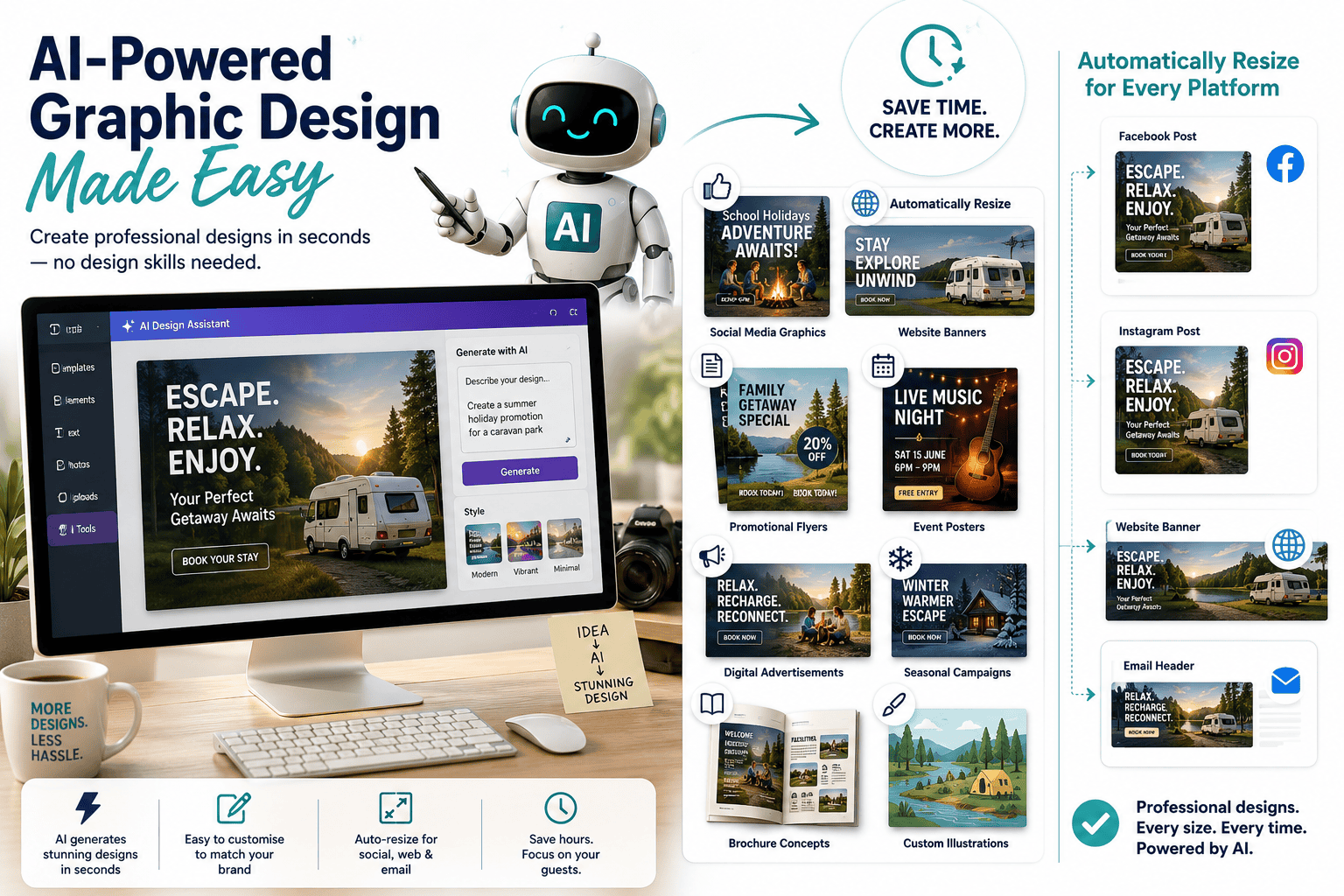
Today, AI-powered design platforms can generate:
- Social media graphics
- Website banners
- Promotional flyers
- Event posters
- Digital advertisements
- Seasonal campaigns
- Brochure concepts
- Custom illustrations
Many tools also resize designs automatically for Facebook, Instagram, websites and email marketing, saving even more time.
6. Managing Maintenance More Efficiently
Maintenance is one of the biggest ongoing challenges for every Holiday Park.
AI can help organise recurring maintenance schedules by reminding teams when cabins require servicing, playground inspections are due, fire equipment needs checking or amenities should undergo preventative maintenance.
Rather than reacting to problems, parks can become more proactive, helping reduce unexpected repairs and improve guest satisfaction.
7. Improving Staff Training
Every new staff member asks similar questions.
AI can help develop customised training manuals, induction checklists, operating procedures and even create role-play scenarios for reception staff dealing with common guest situations.
Some parks are beginning to use AI-powered chat assistants that allow staff to ask questions about procedures at any time rather than searching through folders or manuals.
8. Researching Your Local Market
One of AI’s greatest strengths is summarising information quickly.
Holiday Park operators can ask AI questions such as:
- What major events are happening within 100 kilometres this year?
- What family attractions are nearby?
- Which international visitor markets are growing?
- What competitors are offering?
- What tourism grants are currently available?
- Which local businesses could become marketing partners?
Instead of spending hours searching dozens of websites, AI can provide a useful starting point for planning future marketing activities.
As always, important business decisions should still be verified using official sources, but AI can significantly reduce the research time.
9. Helping With Phone Enquiries
AI is increasingly supporting telephone enquiries through virtual reception systems.
These systems can answer common questions outside business hours, direct calls to the correct department or capture booking enquiries when staff are unavailable.
Importantly, AI shouldn’t replace genuine hospitality.
Guests still value speaking with real people.
Instead, it allows staff to focus on the more complex conversations while routine enquiries are handled efficiently.
10. Brainstorming New Business Ideas
Sometimes the most valuable use of AI isn’t producing content—it’s generating ideas.
Ask AI questions like:
- How can we encourage guests to stay one extra night?
- What activities could increase shoulder season bookings?
- How could we improve our camp kitchen?
- What family events could we run during school holidays?
- What partnerships could we develop with local tourism operators?
- What trends are happening in the Holiday Park / Caravanning Industry that we should be aware of that might suit our Park and Region?
Often the answers spark ideas that managers may never have considered.
Think of AI as a business brainstorming partner that’s available 24 hours a day.
AI Doesn’t Need To Be Perfect
One of the biggest misconceptions surrounding AI is that it always produces perfect answers.
It doesn’t and you need to know that.
Like any staff member, AI occasionally gets things wrong.
It can misunderstand context, make assumptions or provide information that requires checking.
That’s why the most successful businesses treat AI as an assistant—not the decision maker.
The best approach is simple:
- Use AI to create the first draft.
- Check the facts.
- Add your own experience.
- Personalise the final result.
Your knowledge of your guests and your park remain the most valuable asset you have.
AI simply helps you work faster and smarter.
If You’re New To AI, Start Small
Many operators feel they aren’t “tech people.”
The good news is you don’t need to become an AI expert overnight.
Start with one simple task.
Perhaps ask AI to write a Facebook post.
Next week, ask it to draft a guest email.
The following week, use it to create a maintenance checklist.
Confidence grows surprisingly quickly once you begin using it.
There are also thousands of free tutorials on YouTube, short online courses and webinars that demonstrate practical business uses for AI. The key is experimentation. The more specific your instructions, the better the results tend to be.
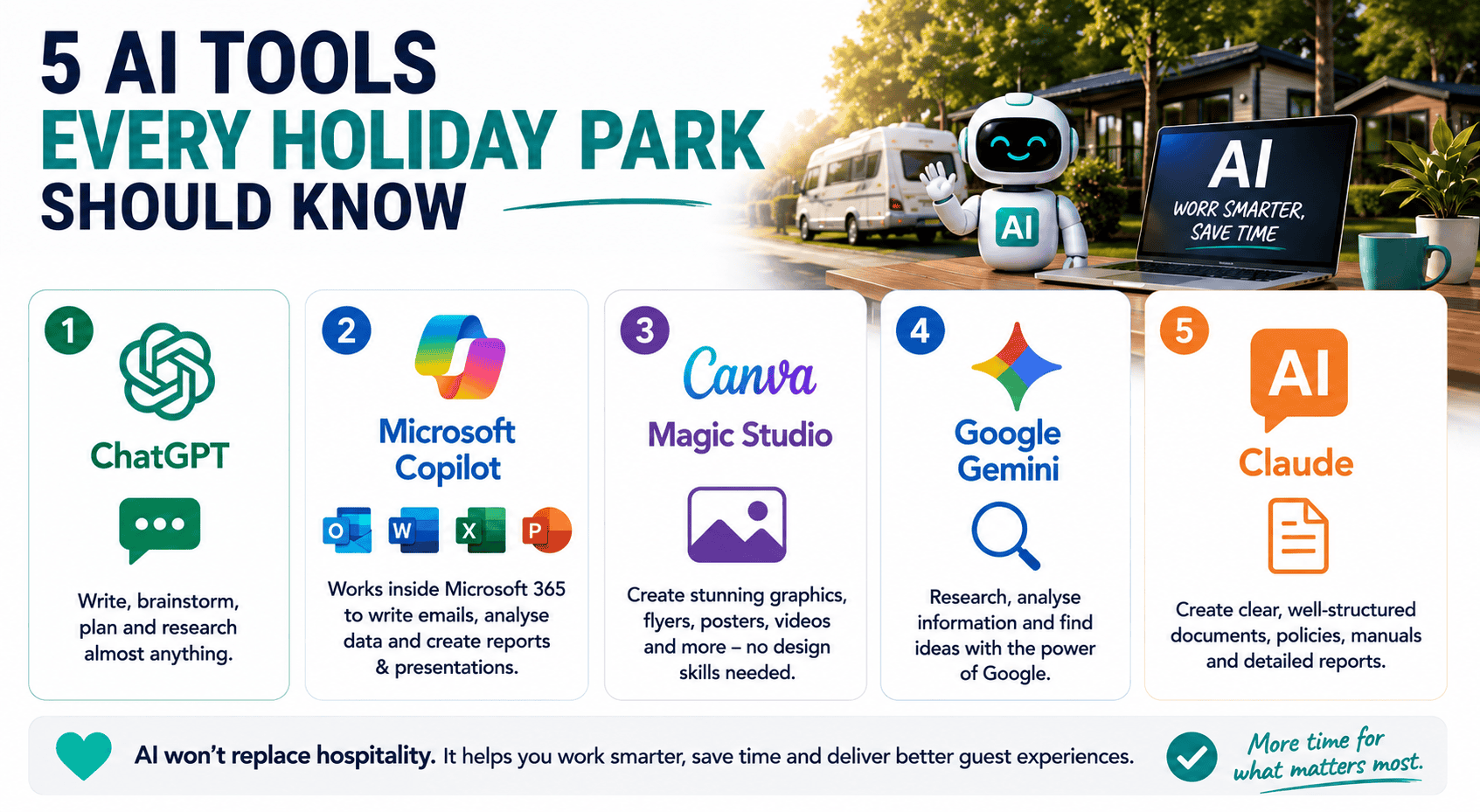
Five AI Tools Every Holiday Park Should Know
While hundreds of AI platforms now exist, these are among the most practical for Holiday Park operators.
1. ChatGPT
Excellent for writing emails, marketing content, guest communications, brainstorming ideas, business planning, staff training material and research. It’s one of the easiest AI tools for beginners and can assist with almost every area of park management.
2. Microsoft Copilot
Ideal for businesses already using Microsoft 365. Copilot works inside Outlook, Word, Excel and PowerPoint, helping draft emails, analyse spreadsheets, prepare reports and create presentations without leaving familiar software.
3. Canva Magic Studio
Many parks already use Canva. Its AI features make it even more powerful, generating social media graphics, brochures, posters, advertisements, videos and marketing material quickly, even for users with no graphic design experience.
4. Google Gemini
Particularly useful for research, planning holidays and analysing large amounts of information. Gemini integrates well with Google’s productivity tools and can assist with brainstorming marketing ideas and local tourism research.
5. Claude
Known for producing clear, well-structured writing and handling longer documents. Claude is particularly useful for drafting policies, staff manuals, operating procedures and refining longer reports or articles.
The Future Isn’t About AI Replacing you or your staff
Holiday Parks have always been about people.
Friendly welcomes.
Helpful advice.
Clean facilities.
Great memories.
No technology can replace genuine hospitality.
But AI can reduce administration, improve productivity, strengthen marketing and give managers back something that’s often in short supply—time.
Those extra hours can then be spent where they matter most: engaging with guests, supporting staff and continuing to build exceptional Holiday Park experiences.
For parks that embrace AI thoughtfully, the opportunities are endless and growing.