The Australian Caravan Industry Isn’t Dying… It’s Changing
By Warren Parrot
For those who don’t know me, for the last 30 years I have worked to promote the Caravan
Industry in Australia producing many TV Shows and other associated media. As
caravanners you will likely have heard of some of them such as Discover Downunder,
Australia’s longest running TV Show – What’s Up Downunder, Tough Tested, Camper Deals
and The Offroad Adventure Show.
I have spent years working alongside the state and national caravan associations around
Australia along with the vast majority of Caravan Manufacturers, Caravan Dealers,
Suppliers, Holiday Park Chain groups, Tourism bodies and more, I know this industry.
There have been far too many headlines over the past 18 months that none of us wanted to
read.
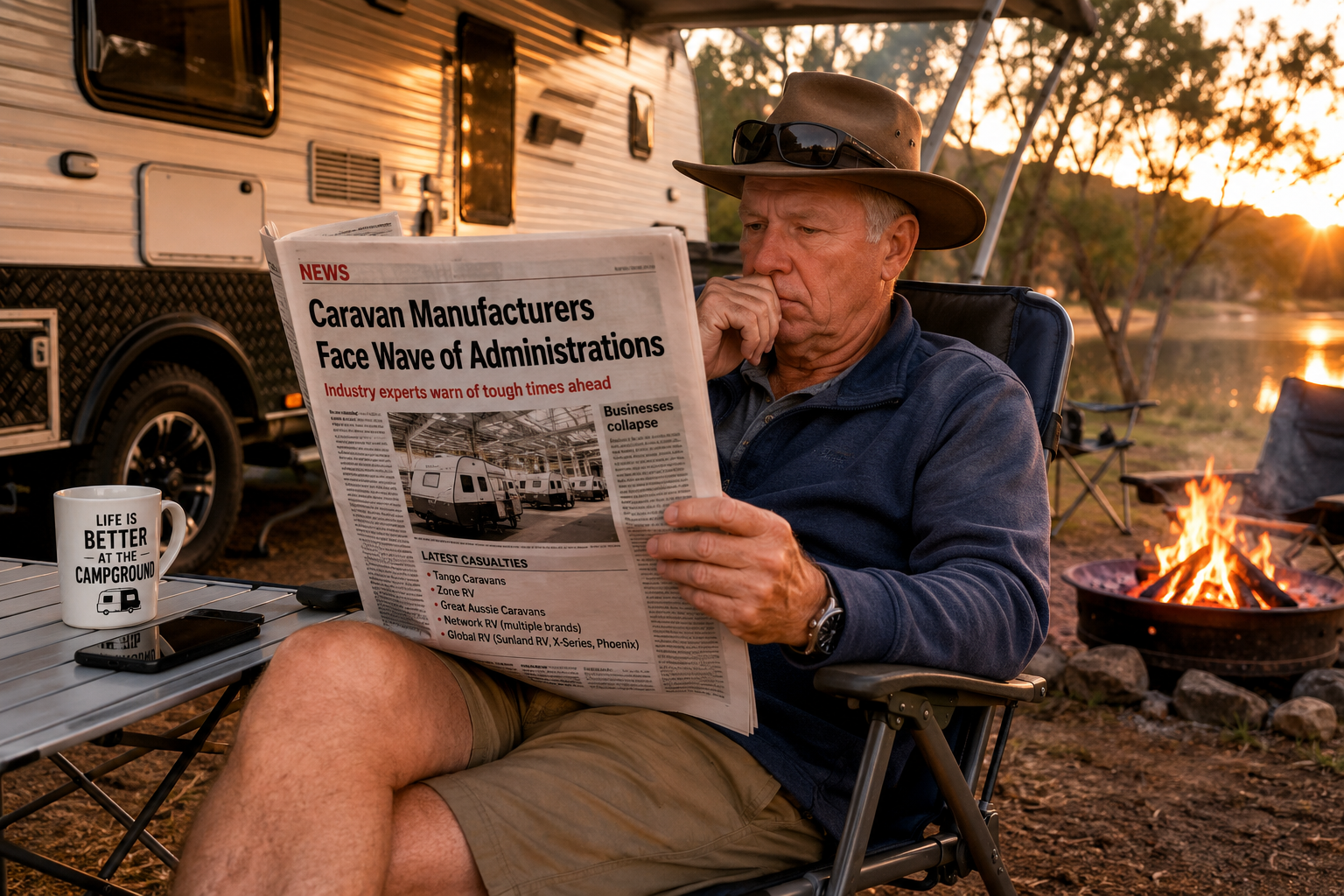
Tango Caravans, Highline Caravans, Zone RV, Great Aussie Caravans, Network RV and the
brands under its umbrella and most recently, Global RV, including the Sunland RV, X-Series
RV and Phoenix brands amongst others have all met their demise for one reason or another.
Every one of those names represents more than just another business entering
administration or liquidation. Most represent somebody’s dream. Somebody’s life’s work.
Hundreds of employees and suppliers. Dealers. Families. And, importantly, at the other end,
the customers who simply wanted to buy the caravan they’d been saving years to own.
Recent insolvencies have left many consumers out of pocket and have become some of the
most talked-about stories the industry has faced in decades.
As mentioned, I’ve worked in and around the Australian caravan industry for more than 30
years.
I know most of the owners. Many of them aren’t just business acquaintances—they’re
friends.
Some I’ve worked alongside for decades.
I’ve also deliberately kept my distance from those manufacturers whose reputations
suggested they weren’t operating the way I believed businesses should. Every industry has
its cowboys. The caravan industry is no different.
But the overwhelming majority of the people I’ve met over three decades are good people.
Honest people. Hard-working Australians who genuinely love the industry and building
caravans to help families discover this incredible country.
That’s why the current situation hurts.
Not because businesses fail—that unfortunately happens in every industry—but because of
the perception it creates.
Consumers start asking one simple question. “Can I trust anyone?” or “Who can I trust?”.
That, to me, is the greatest danger facing Australian caravan manufacturing.
This Didn’t Start Yesterday
When I started promoting this industry all those years ago there were around 40 Caravan
Manufacturers in Australia. In 2026, that number is much higher.
Many people point the finger at Chinese imports as to what is happening in the industry.
Others blame rising interest rates. Some blame COVID. Some the cost-of-living crisis. Some
the Government. More recently the war in the middle east.
The truth? It’s all of the above. The Australian caravan industry didn’t suddenly hit a wall.
It’s been slowly building toward this moment for years.
COVID gave our industry something nobody had ever experienced before—a sales boom
unlike anything seen before in the entire history of the industry.
Australians couldn’t travel overseas. Families wanted freedom. Grey Nomads dusted off
travel plans and got busy. First-time buyers entered the market in record numbers. Order
books stretched from weeks, months into years.
At the time it felt like the best thing that had ever happened. Looking back, it was also the
beginning of many businesses’ biggest challenge.
Manufacturers sold caravans at fixed prices. Demand was high. Order books pushed out.
Customers were understandably happy to wait or had to wait 12, 15 or even 18 months for
their van to be built and delivered.
The problem was that while those customers were waiting, almost everything required to
build those caravans became dramatically more expensive.
Steel. Timber. Composite materials. Suspension. Appliances. Windows. Freight. Shipping.
Labour. Insurance. Electricity. More… and the prices didn’t change once or twice, prices
across the board were changing on a daily basis. Manufacturers trying to keep up with
consumer demand, were also dealing with Covid issues, keeping up with the daily price
increases, logistical issues with closed boarders etc
Almost every input cost increased. Regularly.
The caravan sold for $90,000 in 2021 might have cost close to that—or more—to build by
the time it rolled off the production line.
Multiply that across hundreds and thousands of orders and suddenly businesses weren’t
making money. They were losing it.
Many manufacturers were effectively working harder just to lose more. One long running
Manufacturer, a mate of mine, told me that his business, when all said and done, had lost a
few million dollars during the so-called Covid Boom simply trying to keep up with the
changes and manage the situation.
That wasn’t unique to his business, or to caravan manufacturing.
Businesses across Australia, in all industries, have been fighting similar pressures, with
insolvencies reaching record highs (in fact every year since Covid started has been a record
year – some 30,000 in the last 12-18 months) as the broader economy continues to grapple
with inflation, higher borrowing costs and softer consumer spending.
The COVID Hangover Is Real
People often say COVID is over. They’re right. Mostly. But most small businesses in
Australia, and around the world, are still dealing with and still trying to clean up the damage
and debt that the virus, and many poor government decisions have left behind. Many
everyday workers and consumers think it’s in the past, even government behaves like it is –
but most small to mid-sized businesses know that it isn’t.
And the caravan industry’s COVID hangover certainly isn’t.
COVID didn’t create thousands of extra caravan buyers. It simply brought many purchases
forward.
Families that might have bought a caravan in 2026 bought one in 2021, 2022 or 2023. Grey
Nomads who were planning to upgrade in five years upgraded immediately.
Once borders reopened, overseas holidays returned. Interest rates climbed. Cost-of-living
pressures squeezed household budgets.
Suddenly demand slowed.
The pipeline that had been overflowing was now looking thinner. One Manufacturer during
covid had boasted to me “Waz, we don’t need to advertise at the moment, we have 2 years
of orders in the system, we don’t need more sales”.
When the Covid boom came to a screaming halt a couple of year ago, and the industry
slowed down dramatically, that 2-year order bank reduced to 3 months within a 6 month
period. The reason: Dealer Stock orders. Dealers wanting to ensure plenty of stock in their
yards, who couldn’t get vans to sell fast enough, were ordering what they thought they
needed.
So, when the industry slowed dramatically, their dealerships full, the stock cancellations
started, and the Manufacturers order banks disappeared overnight.
Dealers now had full yards with product they could no longer sell. Manufacturers factories
slowed to a trickle overnight. The financial cost of Covid landed and now had to be dealt
with.
That’s the hangover, and it’s still going.
The Rise of Imported Caravans
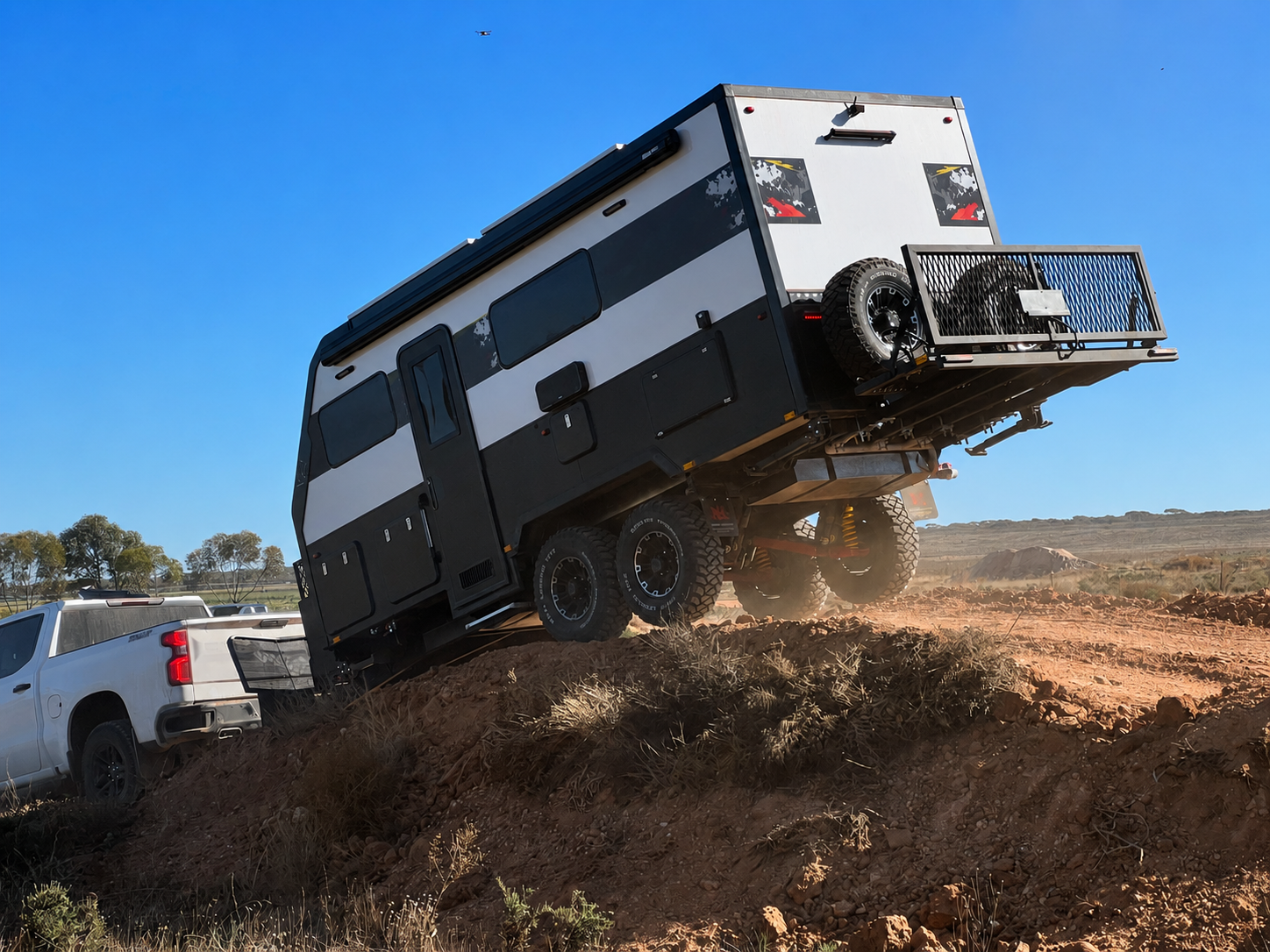
Let’s also address the elephant in the room. Imported caravans.
Twenty years ago, imports were largely camper trailers. Brands like MDC, EzyTrail and Mars
helped introduce Australians to affordable off-road camping.
Whilst highly affordable at the time, even those brands would agree that the quality ‘at that
time’ had a lot of work in front of it.
Over time those companies, and others that entered the market evolved, the quality got
better.
After conquering the Camper Trailer Market over that time, leaving many Australian Camper
Trailer Manufacturers closing down, facing Administration and disappearing, they turned
their attention to Caravans.
They started importing caravans in much greater numbers. Quality at first leaving a lot to be
desired, but evolving overtime to offer good value for money.
Brands like Snowy River Caravans demonstrated that many consumers were willing to
accept imported manufacturing if it meant owning a modern caravan at a significantly lower
price.
And here’s where this conversation often becomes unnecessarily emotional.
Imported caravans are not the enemy.
Whilst they are imported, the brands who do so are Australian (in most cases) run by
Australians, employing Australians, adding to the Australian economy.
Australian manufacturers are not the enemy either. They’re simply competing under very
different cost structures, and to be fair to them, not always under the same set of rules.
If two caravans look similar and one is $10,000, $20,000 or $30,000 or $40,000 cheaper,
many Australian families simply can’t ignore that difference. Particularly in today’s economy.
That’s not anti-Australian. That’s reality. Would most Australians prefer to buy Australian-
built?
Absolutely. I honestly believe they would.
But families also have mortgages, power bills, rates, rent, taxes, school fees, fuel costs
(thanks Donald!), groceries and more that they are grappling with on an ever changing day
to day basis.
When every dollar matters, value becomes incredibly important.
Imports have forced Australian manufacturers to rethink how they compete. That isn’t
necessarily a bad thing.
Competition usually makes industries better.
Did We Simply Have Too Many Manufacturers?
This next point might be controversial.
I actually think Australia had way too many caravan manufacturers even when I first started
in the industry 30 odd years ago.
At the end of 2025 there were well over 200 caravan brands being built by around 180
manufacturers.
That’s an extraordinary number for a country our size. To put that in perspective, the USA
has a population of 330 Million +. Their local industry comprises of a core group of 9-10
Manufacturers who collectively own around 35 brands. Yet we have been trying to sustain an
industry in Australia with many more players and less than 10% of the USA population. It
was never going to be sustainable in the long term.
But why are there too many? The barriers to entry are surprisingly low.
If someone had enough money, a shed and a few skilled staff, they could build caravans.
Whose going to stop them?
In many ways that’s a wonderful example of Australian entrepreneurship.
Unfortunately, it also meant the market became incredibly crowded.
Too many fighting over a small piece of the pie. Margins became thinner. Competition
became fiercer. Consumers had hundreds of choices. Not every business could survive
forever.
Painful as it is to say, some level of consolidation has been inevitable.
It doesn’t make it any easier for the people affected.
But stronger industries often emerge after periods of consolidation.
The Human Cost
This is the part that statistics never capture. This is the part that hurts me personally the
most.
Every administration means somebody loses.
Owners lose businesses they’ve spent decades building. Employees lose jobs. Suppliers
lose customers (and money…), Dealers lose brands and the knock-on effect can and has
been fatal for their businesses.
Families lose income. And consumers lose dreams.
For me, the hardest stories to read have been those involving customers who lost deposits
they’d spent years saving. Retirees. Young families. People who simply wanted to begin
travelling Australia.
Some had sold homes. Some had sold existing caravans. Some had emptied savings
accounts.
To lose that money is devastating. No one should ever underestimate the emotional impact
of that.
But Let’s Keep Some Perspective
Here’s something we shouldn’t forget.
Australians still love caravanning. More than ever.
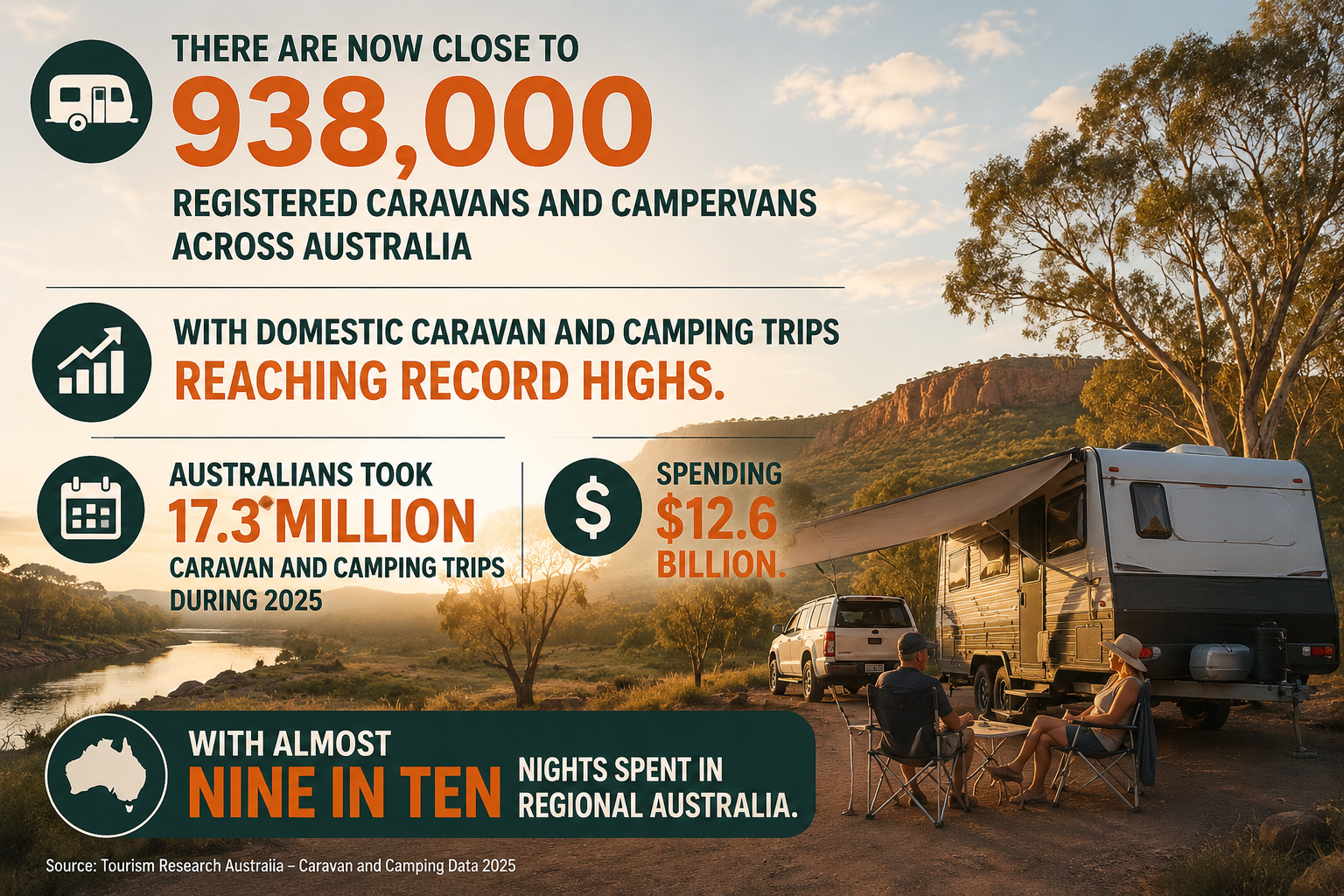
There are now close to 938,000 registered caravans and campervans across Australia,
with domestic caravan and camping trips reaching record highs. Australians took 17.3
million caravan and camping trips during 2025, spending $12.6 billion, with almost nine
in ten nights spent in regional Australia.
The demand for caravanning hasn’t disappeared. Even though reduced since the Covid
high, It’s actually at higher levels than back in 2020. People still want to explore Australia.
They still want weekends away. They still want lap-of-the-map adventures.
The industry itself isn’t dying. It’s changing. Its evolving.
Even the Caravan Industry Association of Australia continues to describe today’s
environment as one of resilience and adaptation rather than decline.
A Few Words of Advice for Buyers
If you’re considering buying a caravan today, don’t panic. Just take your time and do your
homework. Research the manufacturers there are still many great and solid ones out there.
Read independent reviews. Talk to existing owners. Ask how long they’ve been in business –
longevity counts.
Check whether they’re members of recognised industry associations. Look for
manufacturers participating in recognised accreditation programs such as RVMAP or the RV
MASTERS programs, ask them if they are a member of their State Associations.
Whilst these programs and Associations don’t and can’t guarantee anything, the ‘better’
Manufacturers are usually part of these programs and organizations.
Understand exactly how deposits are handled. Read contracts carefully.
If something feels too good to be true, good chance it might be – ask more questions.
Buying a caravan is one of the biggest discretionary purchases many Australians will ever
make.
Treat it that way.
Where To From Here?
I actually believe we’ll look back on this period as one of the biggest turning points in
Australian caravan industry and manufacturing.
The dust will settle. The number of manufacturers will consolidate and reduce.
The businesses that remain will, in many cases, be bigger, stronger and more dependable.
Australian-built caravans will increasingly occupy what they arguably do best—premium,
innovative, custom-built products designed specifically for Australian conditions.
Imports will continue to serve an incredibly important role by making caravanning accessible
to more Australians.
Both can coexist. Both have a future. Most importantly, Australians will continue doing what
they’ve always loved doing.
Hooking up the caravan. Packing the fridge. Loading the fishing rods. Throwing the kids—or
the grandkids—in the car. And heading down another Australian road.
As someone who has spent more than three decades watching this remarkable industry of
great people evolve, I genuinely hope the next chapter is kinder than the last several years
have been.
I hope the businesses that survive are those that have built their reputations on honesty,
quality and standing behind their customers.
I hope the incredible people I’ve been fortunate enough to know and call friends over the
years are among them.
Because behind every caravan rolling out of an Australian factory isn’t just aluminium,
timber, composite panels and wheels.
It’s somebody’s livelihood. Somebody’s passion. Somebody’s dream.
And those dreams are worth fighting for.